4 min read
Hi, I'm Loai: a frontend developer who likes fast, boring code
Who's behind this blog: a senior React and Next.js developer in Cairo, what I build, and what to expect here.
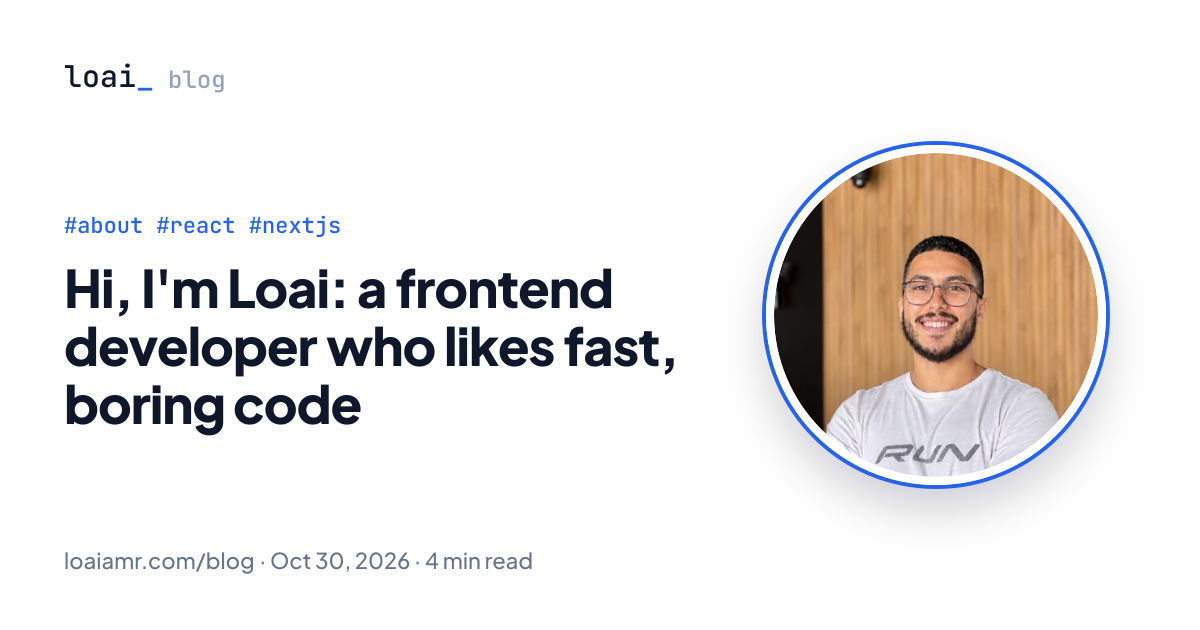
I'm Loai, a senior frontend developer in Cairo. This blog is where I write down the things I'd tell a teammate over a code review: what worked, what broke, and what I'd do differently. Here's who's writing, what I work on, and what you can expect from these posts.
What I do all day
I lead frontend architecture at Webelocity, a Canada-based team where I've worked remotely since September 2022. Most of that time has gone into a B2B eCommerce platform that serves 20+ storefronts, so my days are mostly React, Next.js and TypeScript, at a scale where a small decision in a shared component shows up on every store.
The work changed when I moved from frontend developer to senior in October 2024. Before, I built features: responsive storefronts, component libraries, Redux Toolkit and React Query for the messy data flows, REST and GraphQL integrations, and Jest plus React Testing Library to keep it all honest. Now a bigger part of the job is the stuff around the code:
- setting component architecture patterns and coding standards the whole team follows
- reviewing frontend code and setting testing standards
- mentoring junior developers on React and performance
- keeping the CI/CD pipelines in GitHub Actions healthy
If that sounds like less coding, it isn't. It's coding with more people reading over your shoulder, which is a different (and very useful) kind of pressure.
Things I've built
The project I'm proudest of is ToolSwift, a B2B commerce platform where one catalog runs each dealer's storefront, contractor dashboard and branded mobile app. I worked on every side of it:
- an admin dashboard where dealers run products, quotes, orders, inventory and customers across locations
- a customer dashboard where contractors reorder past jobs, track orders and pay invoices with their own pricing
- the marketing site and the dealer storefronts built on the platform
- the dealers' branded mobile app, plus parts of the backend API
I also built the client-facing sites and dashboards for ONE MORE and Witan Advisory. Witan includes an AI-assisted workspace for CFOs, auditors and analysts, which is a fun design problem: lots of data, users with very little patience, and zero tolerance for a number that looks wrong.
Before and alongside Webelocity, I freelanced from 2021 to 2024 on Upwork and Mostaql and delivered 50+ frontend projects. That's also where my Shopify and WordPress side comes from: custom storefronts, Liquid theme work, Elementor and WooCommerce builds, and headless WordPress paired with React. My favorite result from that era is a WordPress agency site that went from a 16.0s load to 1.2s, mostly with boring fixes:
- a proper image pipeline (compressed, responsive WebP instead of full-size uploads)
- deferring and minifying render-blocking scripts
- full-page caching plus a CDN edge cache
- trimming plugin scripts down to what each page actually uses
None of that is clever. That's the point: most performance wins are discipline, not magic. You can see the full breakdown on my Shopify and WordPress page.
The stack I reach for
If you're curious what my default toolbox looks like, here it is as data, because of course it is:
const stack = {
  core: ["React", "Next.js", "TypeScript"],
  state: ["Redux Toolkit", "React Query", "Zustand", "Context API"],
  styling: ["Tailwind CSS", "SCSS", "modern CSS"],
  testing: ["Jest", "React Testing Library", "Playwright", "Cypress"],
  data: ["REST", "GraphQL"],
  ship: ["Vercel", "GitHub Actions", "AWS", "Cloudflare"],
} as const;
My bias is simple: pick the boring tool that the next developer already knows, make the component boundaries obvious, and measure performance instead of guessing.
Side projects
I like building small things for myself and giving them away:
- Goals Tracker is an offline-first PWA for saving toward a goal. No account, no ads, and your numbers never leave your device.
- shop.loaiamr.com sells an Elementor × Claude skill that gets Claude to build real Elementor pages with native widgets and Containers, the way I'd build them by hand.
This site is a side project too. It's Next.js on Vercel, and this blog runs on Supabase with on-demand revalidation, so a new post goes live without a redeploy.
What to expect here
Short, practical posts for developers who ship. Expect topics like:
- React and Next.js patterns that hold up in real codebases
- CSS features that are finally safe to use in production
- web performance, with numbers, not vibes
- WordPress, Shopify and Elementor tricks from client work
- AI-assisted dev tools: where they actually save time, and where they don't
Every post should have working code, a clear takeaway, and links to the sources behind any version or feature claims. If something's wrong, I want to know.
Takeaway
I'm a frontend developer who cares about fast, tested interfaces and code the next person can live with. If that's your kind of thing, subscribe to the RSS feed, and if you're building a React or Next.js product and want to talk, my inbox is open at loaiamr@gmail.com.